Home »
News»
Nation
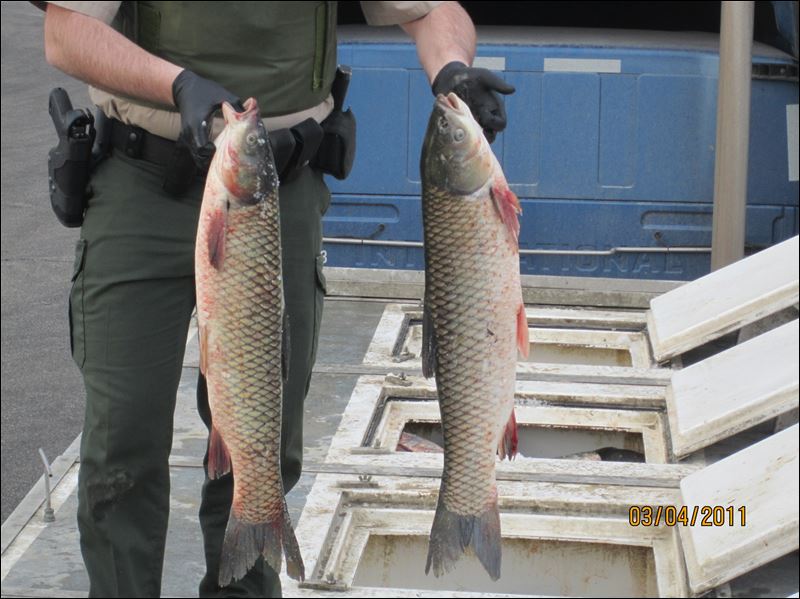
A Canadian conservation officer holds Asian carp seized at the border.
ONTARIO NATURAL RESOURCESEnlarge
WINDSOR, Ont. -- While the battlefront in the war to keep the Asian carp out of the Great Lakes has been in the canals near Chicago or in the marshy area outside Fort Wayne, trucks loaded with thousands of the destructive invasive species likely have been rolling down the interstate highways of Ohio and Michigan, headed for the Ambassador Bridge in Detroit that connects the United States and Canada.
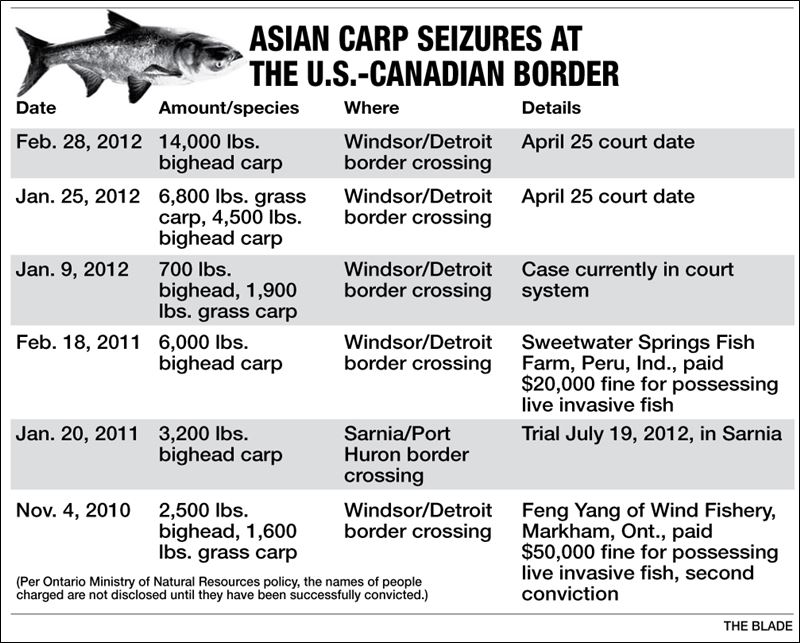
Since the first of the year, Ontario officials have seized three shipments of live Asian carp, totaling more than 23,000 pounds, that apparently were headed for markets in Toronto. Since late 2010, six loads of live Asian carp have been seized at the border.
"This is truly ominous," Paul Pacholski, a Lake Erie charter boat captain, said about the news of the seizures of live Asian carp in the heart of the Great Lakes region. "It's about the most alarming thing we've heard on Asian carp. If one of these trucks flips over and these fish escape into a ditch or a creek, it is going to be a tragedy. Just the thought of that scares the jeepers out of me."
That potential situation had the Canadian Ministry of Natural Resources concerned enough that about a year ago it conducted a meeting, in conjunction with a number of U.S. officials, that was a disaster drill of sorts to determine how such an event would be handled.
"We realized these fish are coming across the border alive, and if a thousand Asian carp were dumped into a suitable waterway, how would we respond," said John Cooper, spokesman for fish and wildlife services in the natural resources agency in Peterborough, Ont. "We were looking at scenarios, such as how quickly could we respond and corral these fish to keep them from moving out into other waterways."
Legal issues
The Asian carp seized at the Canadian border were raised legally on fish farms in the United States. Transporting live Asian carp across state lines is a violation of the U.S. Lacey Act and can bring penalties of up to six months in prison and a $5,000 fine for an individual or a $10,000 fine for an organization. Since 2005, it has been illegal to transport live invasive species into Ontario.
In the two Canadian cases that have gone through the courts, no one involved has served any jail time. One violator paid a $20,000 fine for a first offense, and a repeat offender was fined $50,000 in the second case. The other cases are pending.

Fresh Asian carp command a premium price in Toronto because of their popularity in Asian cuisine.
ONTARIO MINISTRY OF NATURAL RESOURCESEnlarge
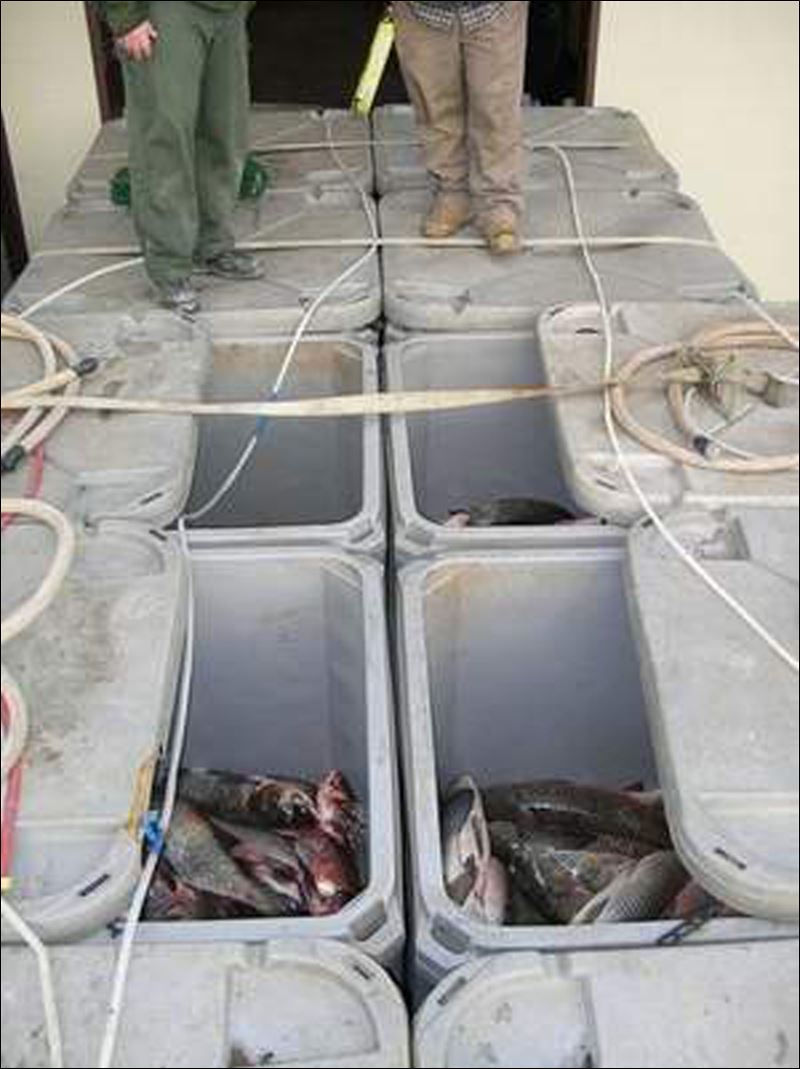
Mr. Cooper said that in 2010, the Ministry of Natural Resources began working with the Canadian Border Services Agency to instruct its agents on what to look for to detect the illegal cargo. The Asian carp often are shipped on trucks that also hold numerous containers of bass or other native species that are legal to move alive into Ontario.
"Since then, the border guards have been much more aggressive in detecting shipments that likely have Asian carp in them," he said.
The protocol on the Canadian side calls for the border agents to alert the Ministry of Natural Resources about the potential presence of invasive species in a load, and the fish and wildlife officers take over from that point.
"The law states that the invasive species can't be alive, but even though they are packed in ice, on some of these trucks many of these fish are still alive," Mr. Cooper said. "These fish are very hardy."
Fish in demand
The market value of the carp is much higher if they are alive or at least fresh when they reach Toronto, where the fish command a premium price because of their popularity in Asian cuisine.
Mr. Pacholski said he believes the fish are kept alive in water when they leave U.S. fish farms, then the water is dumped out, and ice is added very close to the Ontario border crossing. Once the truck clears Canadian customs, water is added to the containers in an effort to keep the fish alive for the remainder of the journey, which can be up to 1,000 miles total, if the fish originated from fish farms in Arkansas.
"I think that's the way they play this," he said. "The Asian market in Toronto prefers them alive, so every effort is made to keep these fish lively the whole way. It's scary to even think about these trucks moving down the highway loaded with this kind of cargo."
The Great Lakes Fishery Commission is playing an active role in helping coordinate the law enforcement on both sides of the border. Marc Gaden, communications director and legislative liaison for the group, said understanding the Asian carp is vital to stopping the movement of the invasive fish.
"These fish have an ability to survive under adverse circumstances, so they can put them on ice and then reconstitute them once they cross the border," he said. "As far as we are concerned, they can ship all of the dead Asian carp they want, but we'd like to see them filleted first. We're not sympathetic at all to the demands of the market."
On the move
"Asian carp" is a generic term that covers four species of nonnative fish -- bighead, silver, black, and grass carp. The seizures at the Ambassador Bridge international border crossing have involved bighead and grass carp.
Grass carp were brought into the United States in the 1970s to reduce vegetation in rearing ponds on fish farms, and bighead carp have been used to clean sewage ponds. These Asian carp escaped about four decades ago during periods of flooding and made their way into the Mississippi River system.
They have pushed north with little hindrance ever since and dominated the waterways where they are present. In certain stretches of the Mississippi that once held significant populations of native fish such as bass and crappie, as much as 90 percent of the fish stock is made up of Asian carp.
The carp have surged to within a few miles of Lake Michigan, where only an electrical barrier is keeping them from the Great Lakes. At Eagle Marsh southwest of Fort Wayne, a chain-link fence stretches across the middle of the low-lying area where, in periods of flooding, the headwaters of the Asian carp-infested Wabash River system could mix with those of the Maumee River system, which feeds into Lake Erie.
Those are believed to be the two points of highest vulnerability in the multinational, multistate, multiagency effort to keep the ultraaggressive and prolific Asian carp from reaching the Great Lakes and potentially destroying its $7 billion-a-year sport-fishing industry and threatening the 5 million jobs and the $62 billion in wages associated with the Great Lakes.
Mr. Gaden lauded law enforcement officials on both sides of the border for their efforts to give the illegal transportation of these invasive fish the attention he said it deserves. But he still expects a long-term battle to be necessary.
Taking a hard line
"More can be done to stop this. We need to make examples of the repeat offenders and make the penalties hurt," he said. "We didn't fight for more than a decade to get these fish listed under the Lacey Act just to have people ship them all over the place in clear violation of the law. The movement of these fish has to stop."
Tina Shaw, public affairs specialist for law enforcement issues with the U.S. Fish and Wildlife Service's office in St. Paul, said the movement of Asian carp across state lines is a subject the agency is focused on.
"It is absolutely a very big concern for us. Lacey Act violations are something we target," she said.
"As with all law enforcement matters, it is important not to show your cards, but we are actively working on this issue."
Asian carp are notorious for their voracious appetite and their size. They can grow to 100 pounds and consume a quarter of their body weight a day by filter-feeding for plankton and other microscopic organisms. Because of their size and numbers, Asian carp rob the food web that supports other native species and quickly dominate the waterway.
Contact Matt Markey at: mmarkey@theblade.com or 419-724-6068 .